Gearbox repair or exchange?
How to compare your options.
The right decision starts with the fault, the vehicle and the complete scope of work. Here’s what to ask before you commit.
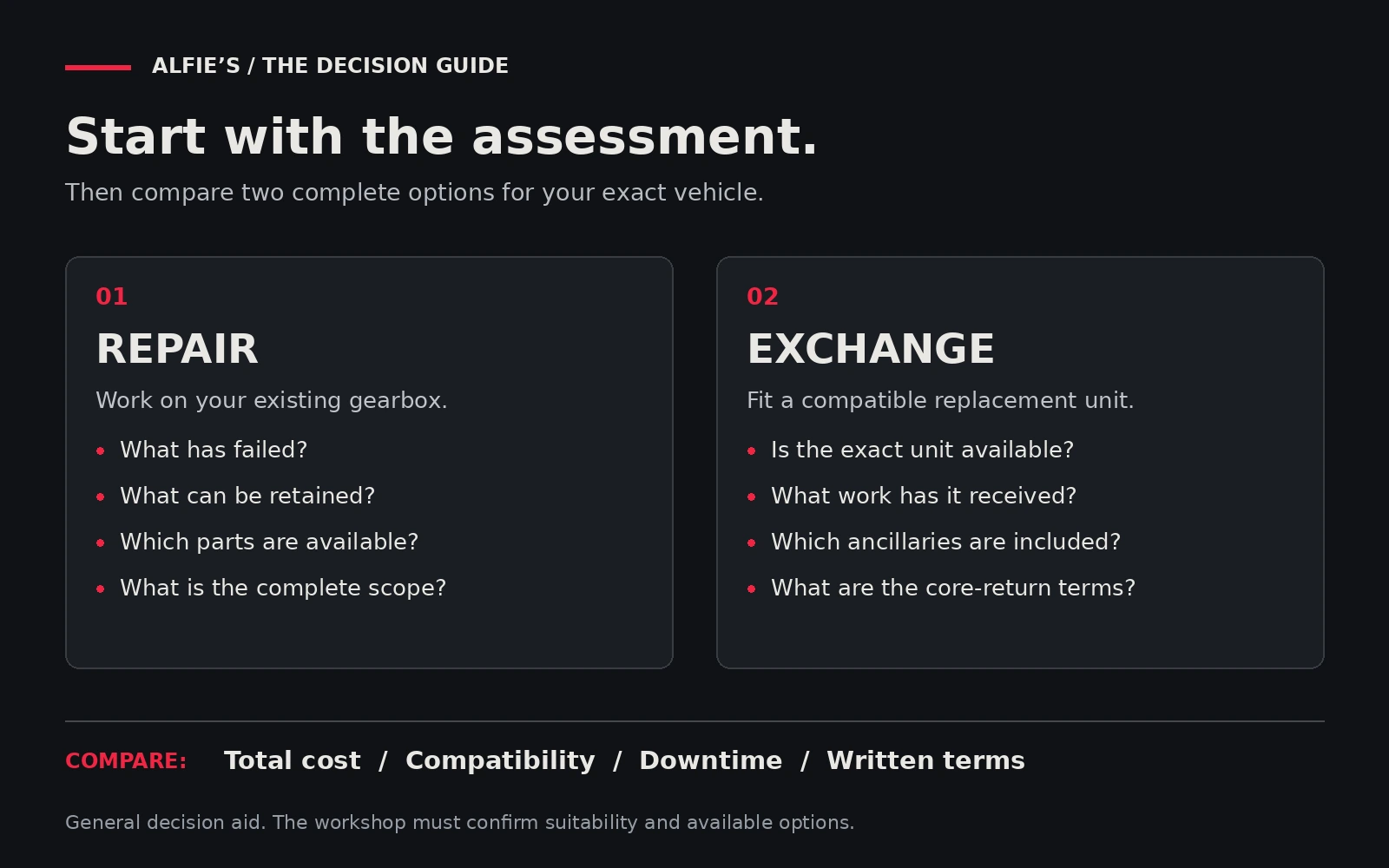
Repair makes sense when the assessed damage can be addressed effectively in your existing gearbox. An exchange is worth comparing when a suitable replacement offers a better overall combination of condition, availability and cost. Neither option is automatically cheaper or quicker. Start with the diagnosis, then compare the complete job.
A gearbox problem can turn a normal week into a difficult decision. You need the car for work, the bakkie for deliveries or the family vehicle for school runs. Someone suggests repairing the gearbox; someone else says an exchange will get you moving sooner. Before committing, it helps to know exactly what those options mean.
This guide explains how to compare gearbox repair versus exchange without relying on a headline price or a promise that may not apply to your vehicle. Alfie’s offers gearbox repairs and exchanges at its Nigel workshop. The right scope must be confirmed for your vehicle and the fault found.
Repair and exchange: what is the difference?
Repairing your existing gearbox
A repair keeps your existing unit as the starting point. Depending on the findings, the work may be confined to a specific problem or involve more extensive internal attention. The important question is which parts are damaged, which remain serviceable and what work is needed to address the cause.
“Repair” does not describe one fixed package. An external leak and widespread internal damage are very different jobs. Ask what has been assessed, what remains uncertain and whether further dismantling is needed before the final scope can be agreed.
Choosing an exchange gearbox
An exchange generally means supplying a replacement unit against the return of your old gearbox, often called the core. The exact arrangement varies. Confirm what you receive, what condition it is in and what happens to the original unit.
An exchange gearbox is not necessarily new. Descriptions such as used, repaired, reconditioned and remanufactured need explanation. For example, ZF describes a defined remanufacturing process involving disassembly, inspection and testing. That manufacturer’s process does not establish what any particular Alfie’s exchange unit includes; request the details for the unit being quoted.
First, confirm that the gearbox is the problem
A difficult gear change does not, by itself, prove that the gearbox needs replacing. On a manual vehicle, a clutch that does not release correctly can make gear selection difficult. SACHS guidance on clutch disengagement identifies possible faults in the release system as well as the clutch itself. This is a reason to assess the whole system rather than buy a gearbox based on a symptom alone.
Give the workshop useful observations: which gear is affected, whether the problem occurs cold or warm, whether it started suddenly and what work was done recently. Dashboard messages, leaks and changes in noise are also worth mentioning. Do not repeatedly provoke the fault to demonstrate it.
Ask: “What findings support this recommendation, and what will the proposed repair or exchange address?” A clear answer helps you understand the scope and any uncertainty that remains.
When a repair is worth considering
Repair is worth discussing when the problem has been identified and the existing unit remains a suitable basis for the work. That decision depends on assessed damage, parts availability and the condition of related components. It also depends on whether repairing one fault leaves other significant issues unresolved.
Consider an illustrative example: a car has a confirmed leak, but the assessment does not identify wider internal damage. A targeted repair may be a reasonable option to compare. If the same car also has extensive wear or damaged internal components, the scope changes. These are examples of decision-making, not accounts of Alfie’s customer jobs.
A useful repair estimate explains the immediate work and the circumstances under which it might expand. Ask how you will be contacted if dismantling reveals additional damage and whether further costs require your authorisation.
When an exchange deserves a closer look
An exchange may be worth comparing when the original gearbox requires extensive work, important parts are difficult to obtain or a correctly matched replacement is available. It can provide a different route through the job, but availability and suitability must be confirmed.
For a work bakkie, downtime matters alongside the invoice. Ask when the specific unit can be supplied, what fitting work is required and what still needs checking before collection. A gearbox sitting on a shelf does not necessarily mean the vehicle can be completed immediately.
Compatibility deserves particular attention. Make and model alone may be insufficient: engine variant, transmission code, build details, mounting arrangements and controls can matter. Provide the vehicle information the workshop requests before ordering.
Compare the complete cost of getting back on the road
One quote may cover a gearbox supplied loose; another may include removal and refitting. Those figures cannot be compared fairly until you know what each includes. Request written detail on:
- Assessment and labour: diagnosis, removal, dismantling and refitting where applicable.
- The unit or parts: precisely what will be supplied, repaired or replaced.
- Related items: required fluids, seals, fittings and other work identified during assessment.
- Completion: relevant checks and any vehicle-specific commissioning procedure.
- Exchange conditions: core return, any deposit, transport and acceptance requirements.
- Written terms: applicable warranty, exclusions and follow-up instructions.
These are questions to ask, not a statement of inclusions in Alfie’s packages. Confirm VAT treatment and any extra charges too. The most useful comparison is the expected total for the agreed scope, with uncertainties clearly identified.
Think beyond the gearbox itself
Your ownership plans matter. Keeping a sound vehicle for several more years is a different decision from preparing an older car for sale. Consider the vehicle’s overall condition, other upcoming repairs and how much you depend on it. There is no universal mileage at which a gearbox repair becomes worthwhile or uneconomical.
Also ask how the cause of the problem will be addressed. Replacing or repairing a unit without understanding the original fault can leave a related issue unresolved. Depending on the vehicle, that discussion may involve the clutch, actuation, controls or other associated systems.
For more background on the questions to ask about written coverage, read Alfie’s existing guide to gearbox repair warranties and after-service support. The terms for your particular job still need confirmation.
Frequently asked questions
Is an exchange always cheaper than a repair?
No. It depends on the repair scope, the replacement unit, fitting costs and exchange conditions. Compare written estimates for equivalent completed work.
Can I order an exchange using only the car’s model?
Do not assume that is enough. Ask which vehicle and gearbox identifiers are required to confirm compatibility.
Will my old gearbox need to be returned?
Often that is part of an exchange arrangement. Confirm the return deadline, required condition and any deposit or surcharge before agreeing.
How long will the work take?
The workshop must confirm an estimate after considering the findings, parts or unit availability and fitting requirements. Ask what could change the expected collection date.
Prepare a useful enquiry for the Nigel workshop
Have your make, model, engine details and mileage ready. Describe the symptom and when it happens, and include relevant repair history. If you are enquiring about a loose component, provide its identification and photographs when requested. Call first to discuss the vehicle or unit and arrange the next step.
If the vehicle cannot engage a gear reliably or is behaving unpredictably, avoid further driving and ask about suitable recovery. Follow the vehicle manufacturer’s instructions; towing arrangements differ between vehicles.
Let’s discuss your gearbox.
Speak to Alfie’s Gearbox & Diff Centre about repair and exchange options for your vehicle.
078 838 2686
info@alfiesgearbox.co.za
68 Springs Road, Nigel, 1590
Monday–Friday · 08:00–17:00