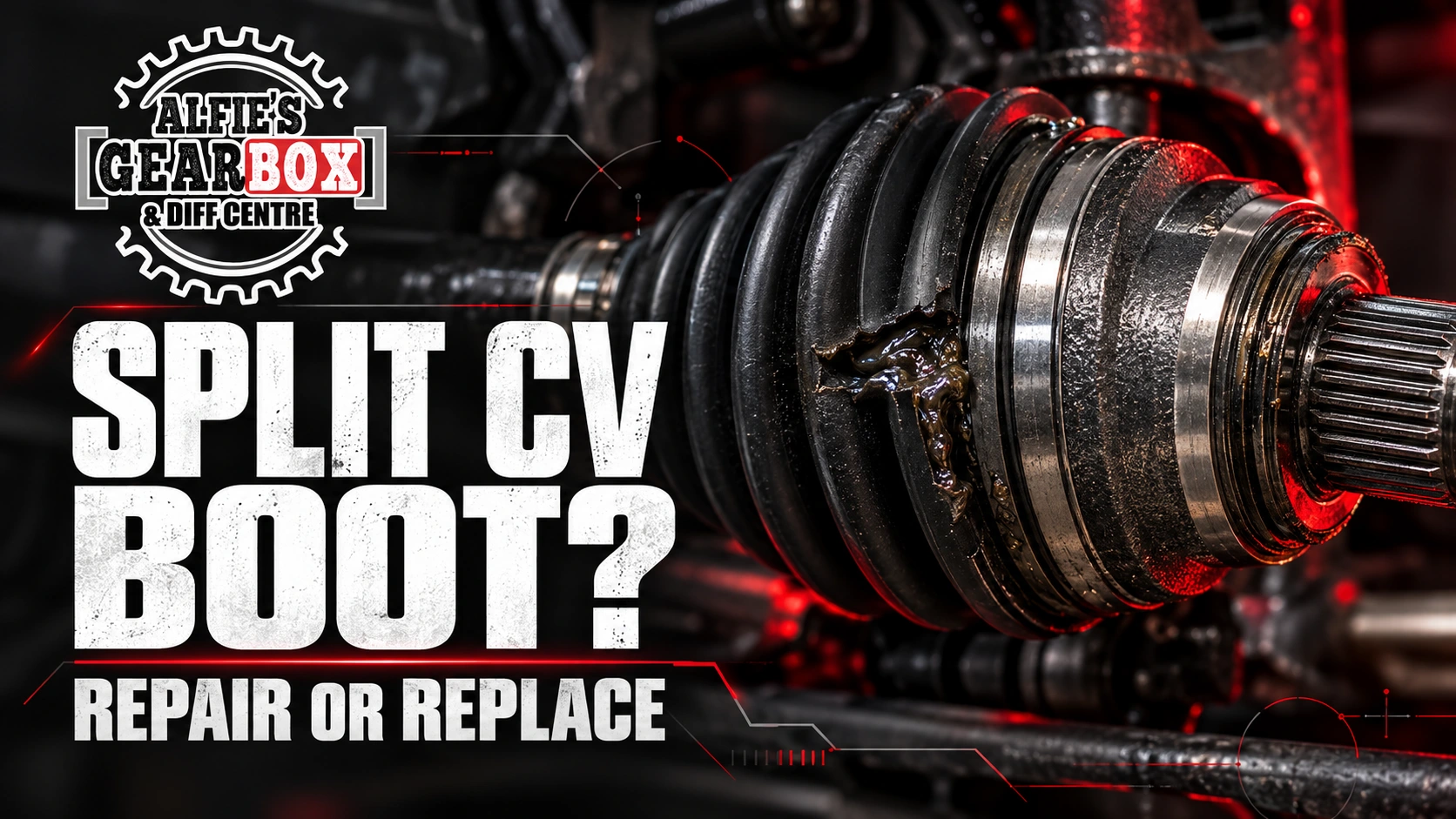
Split CV Boot: Boot Repair or Joint Replacement?
A damaged boot and a damaged joint are different repair questions. Find out why the joint’s condition matters, and what a useful quote should cover.
A split CV boot needs prompt assessment. Replacing the boot may be appropriate if the joint remains serviceable, while wear or damage can make joint or driveshaft replacement worth comparing. A new boot cannot reverse damage already inside the joint.
Grease on the inside of a wheel or a torn rubber cover near the driveshaft can be easy to overlook. The vehicle may still feel normal. Yet the boot protects a component that works as the vehicle drives and its suspension moves. Before deciding between a boot repair and joint replacement, establish what has happened to the joint itself.
The boot protects the joint; it is not the joint
A CV joint allows drive to be transmitted through the angles required by the vehicle’s layout. Its flexible boot forms part of the sealing system. It helps retain lubricant and exclude contaminants. A tear, failed seal or loose clamp can compromise that protection.
GKN Automotive’s boot guidance emphasises the importance of correct fit and material for the particular joint. This is why a replacement should be selected for the application rather than judged only by whether it appears to stretch over the shaft.
Why a split boot does not answer the repair question
A damaged cover shows that protection has been compromised; it does not tell you the internal condition. The workshop needs to consider lubrication, contamination, wear and damage. The length of time the split has been present may be uncertain, especially if you found it during another service.
Do not assume that no noise means no damage, or that every torn boot requires a complete driveshaft. Ask what the assessment reveals. A useful recommendation explains why the joint remains suitable for a boot repair or why a more extensive replacement is proposed.
When boot replacement may be worth discussing
If the joint is assessed as serviceable, renewing the damaged boot and carrying out the necessary preparation and lubrication may be a suitable scope. Exact parts and procedures depend on the application and kit. The job is more than putting a new cover over the old one.
Ask whether access or removal is required, how the joint’s condition will be assessed and which boot, clamps and lubricant are included. These are questions for the quote, not a promise of what is included in every Alfie’s repair. Confirm the correct vehicle and joint identification before ordering parts.
When joint or driveshaft replacement deserves comparison
Wear, damage or unsuitable internal condition can change the recommendation. Depending on the vehicle and parts available, the options may include a joint kit or a complete driveshaft assembly. Those descriptions represent different scopes and should be compared accordingly.
Ask which joint is affected, which components will be supplied and whether the existing shaft can be retained. Clarify any related fasteners or seals required for the work. Compatibility, component condition and fitting requirements matter alongside the price printed on the part.
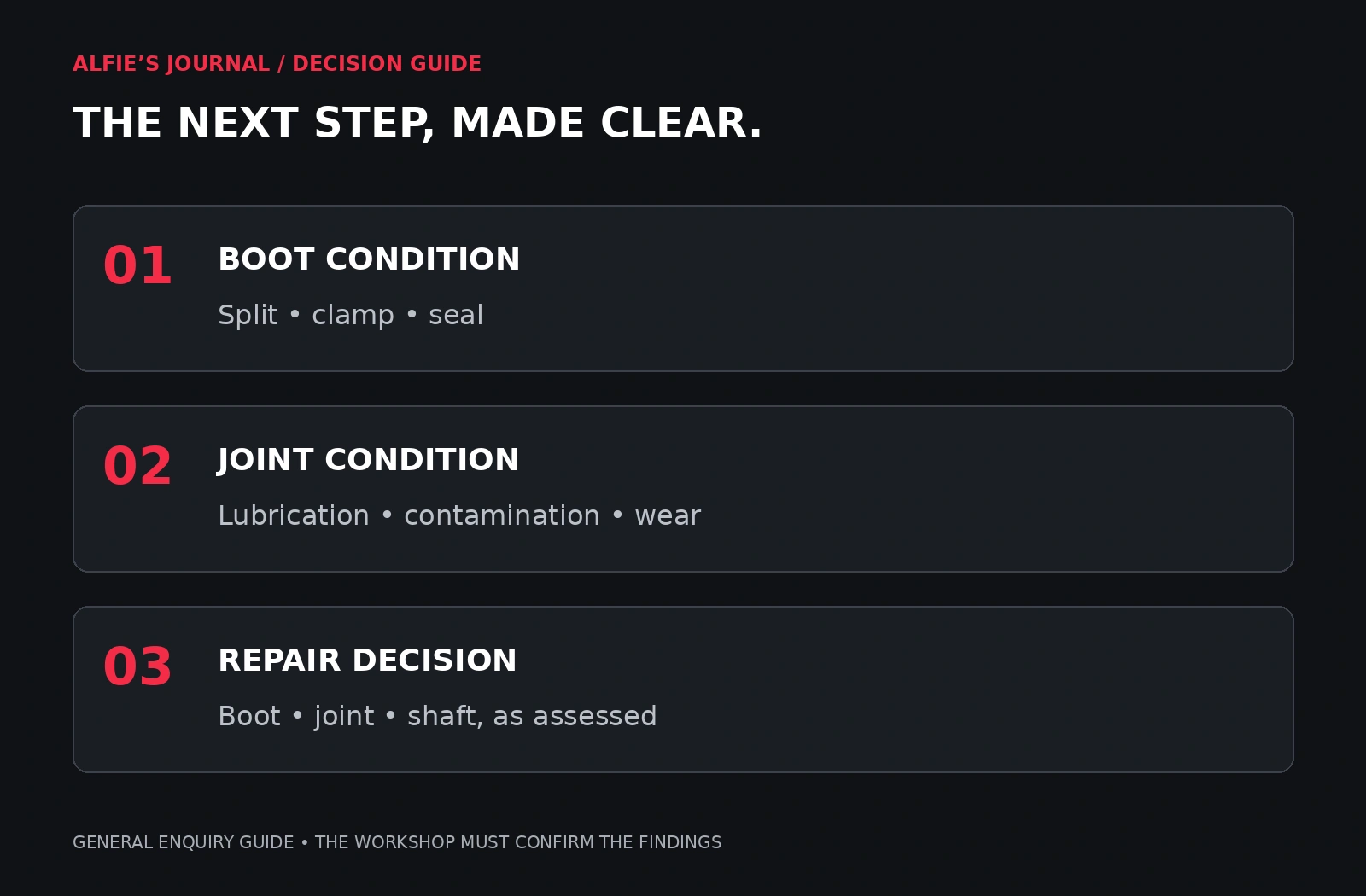
What to tell the workshop before booking
Report where grease was noticed, when the boot damage was found and whether there were noises or vibration during ordinary driving. Mention recent suspension or driveshaft work and any impact history. Those details are useful context, rather than proof of one fault.
Photographs can help identify the area, but do not crawl beneath an unsupported vehicle. Send images only from a safe, accessible position and ask what the workshop needs. Do not deliberately perform tight turns or hard acceleration to provoke a noise for a recording.
Compare quotes for the same completed job
A loose boot kit, a fitted joint and a complete driveshaft replacement cannot be compared as though they were the same purchase. Ask for parts and labour boundaries, required associated items, VAT treatment and any additional charges. Confirm the estimated downtime and what may change it.
If inspection could reveal more damage, establish when you will receive an update and how extra work will be authorised. Request the applicable warranty terms and collection instructions in writing. A clear scope makes it easier to understand what each option is intended to achieve.
Arrange assessment rather than guessing at a safe distance
There is no universal remaining distance for a vehicle with a damaged boot. Condition and symptoms matter. Contact the workshop promptly, describe the findings and ask about bringing the vehicle in. If there is severe vibration, loss of drive or unpredictable behaviour, stop driving and discuss suitable recovery.
For broader background, read Alfie’s CV joint warning-sign guide. To discuss a split boot, contact the Nigel workshop about CV joint services and the assessment needed for your vehicle.
Frequently asked questions
Can a new boot cure clicking or vibration?
A boot restores protection; it does not repair worn joint surfaces. The cause of the symptom must be established and the joint’s condition assessed.
Must both driveshafts be replaced?
Do not assume that. Ask what findings support work on each side and which components are affected.
Is the cheapest boot kit the best option?
Compare correct fit, included parts and the complete fitted scope. The right application matters more than the kit price alone.
Let’s discuss your vehicle.
Speak to Alfie’s Gearbox & Diff Centre about the assessment and work your vehicle needs.
078 838 2686 · info@alfiesgearbox.co.za
68 Springs Road, Nigel, 1590
Monday–Friday · 08:00–17:00