
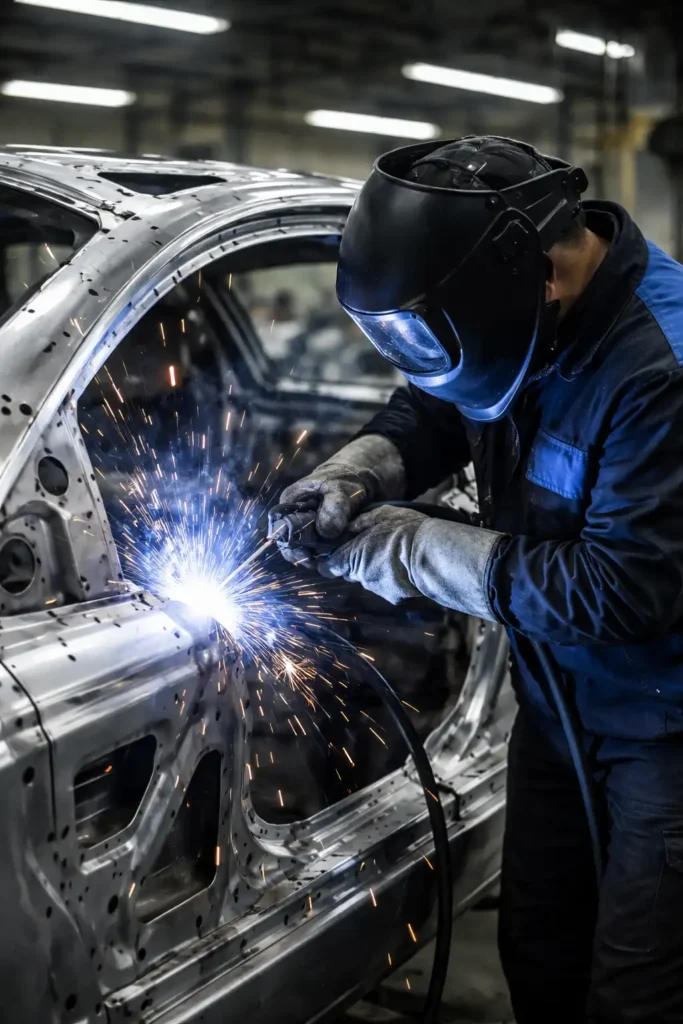
Modern vehicles are built with stronger, lighter materials—and aluminium is leading the way. From engine components to body panels, aluminium plays a critical role in improving performance and fuel efficiency. But when these parts are damaged, repairing them requires specialised skills—especially when it comes to aluminium welding.
In this article, we break down how aluminium welding works, which vehicle parts commonly need it, and why it’s often the best repair option.
What Is Aluminium Welding?
Aluminium welding is a process used to join or repair aluminium components by melting the base material and allowing it to fuse together as it cools.
Unlike steel, aluminium has unique properties:
- It has a protective oxide layer that must be broken during welding
- It conducts heat quickly, making it harder to control
- It requires special equipment and techniques to achieve a strong bond
The most common methods used in automotive repairs are:
- MIG welding (Metal Inert Gas): Fast, efficient, and ideal for thicker parts
- TIG welding (Tungsten Inert Gas): More precise, perfect for delicate or detailed repairs
Both methods use shielding gases like argon to protect the weld from contamination and ensure a clean, durable finish.
How Aluminium Welding Works
At its core, aluminium welding follows a structured process:
- Preparation
The surface is cleaned thoroughly to remove dirt, oil, and oxidation. Contamination can weaken the weld. - Breaking the Oxide Layer
Aluminium’s oxide layer melts at a higher temperature than the metal itself, so specialised current (often AC) is used to break it down - Creating the Weld Pool
Heat is applied to form a molten pool, sometimes with a filler material added to strengthen the joint. - Cooling & Solidifying
The molten aluminium cools and forms a strong bond between the parts.
Because aluminium is sensitive to heat, skilled technicians must carefully control temperature to prevent warping or weakening.
Common Vehicle Parts That Need Aluminium Welding
Aluminium is widely used across modern vehicles due to its lightweight and corrosion-resistant properties . Some of the most common parts that may require welding include:
1. Radiators & Intercoolers
Cracks or leaks in aluminium cooling systems often require precision welding to restore functionality.
2. Gearbox & Diff Housings
Damage to casings can lead to oil leaks or structural issues—aluminium welding provides a durable repair solution.
3. Alloy Wheels
Cracks or fractures in alloy rims can sometimes be repaired through specialised welding (depending on severity).
4. Engine Components
Parts like cylinder heads or brackets may require welding after wear or impact damage.
5. Body Panels
Many modern vehicles use aluminium panels to reduce weight—these require expert repair techniques when damaged.
When Is Aluminium Welding Needed?
Aluminium welding is typically the best option when:
- Cracks or fractures appear in structural components
- There are leaks in radiators, intercoolers, or casings
- Parts need reinforcement rather than replacement
- You want a cost-effective repair instead of buying new components
In many cases, welding restores the part to near-original strength, making it a practical and reliable repair solution.
Benefits of Aluminium Welding Over Alternatives
While other repair methods like adhesives or mechanical fasteners exist, welding often provides superior results.
✔ Stronger, Permanent Repairs
Welding creates a solid bond, unlike adhesives which may degrade over time.
✔ Better Structural Integrity
Mechanical fasteners can introduce stress points or corrosion between metals
✔ Cost-Effective
Repairing a part is usually far cheaper than replacing it entirely.
✔ Lightweight Performance Maintained
Welding preserves aluminium’s key advantage—its excellent strength-to-weight ratio.
Why Professional Aluminium Welding Matters
Aluminium welding isn’t a DIY job. It requires:
- Specialised equipment
- Skilled technicians
- Proper preparation and safety standards
Poor welding can lead to:
- Weak joints
- Cracking or porosity
- Heat damage to surrounding areas
That’s why it’s important to trust experienced professionals who understand the complexities of aluminium repairs.
Trust Alfie’s Gearbox & Diff Centre
At Alfie’s Gearbox & Diff Centre, we specialise in precision aluminium welding for a wide range of vehicle components. Whether it’s a cracked gearbox housing, a leaking radiator, or a damaged alloy part, our team delivers reliable, high-quality repairs that last.
Need aluminium welding done right?
Contact Alfie’s Gearbox & Diff Centre today for expert service you can trust.
 Visit us: 68 Springs Road, Nigel, 1590
 Call: 081 008 5701 / 064 902 3410
 www.alfiesgearbox.co.za